Welcome to our new site for Moements. All our great products available at the click of a button.


Welcome to our new site for Moements. All our great products available at the click of a button.
Flowers, Birds and Insects - Folio 1. Source: Digital Library of Rouen.
Estimated Publication date late 17th - 18th Century, China.
Artist Unknown.
Ink and brush paintings of China's flora, fauna and the ancient art of Penjing*. Two large folios were produced. consisting of 50 artworks depicting elaborate and colourful pots of flowers, blossom trees, birds and rocks. And another 50 artworks of miniature fruit trees, rocks, butterflies and other insects in equally ornate pots. The Chinese had a passion for trees, flowering plants and gardens. In fact, many Chinese gardens were on a miniature scale and included many miniature trees and shrubs planted to reinforce the scale and balance of their landscapes.
* Penjing, literally meaning "tray scenery" is the ancient art form of potted landscape of miniature trees, plants, rockery and other scenes. It originated first in China in 600AD. Bonsai appeared in Japan in the 12th century.
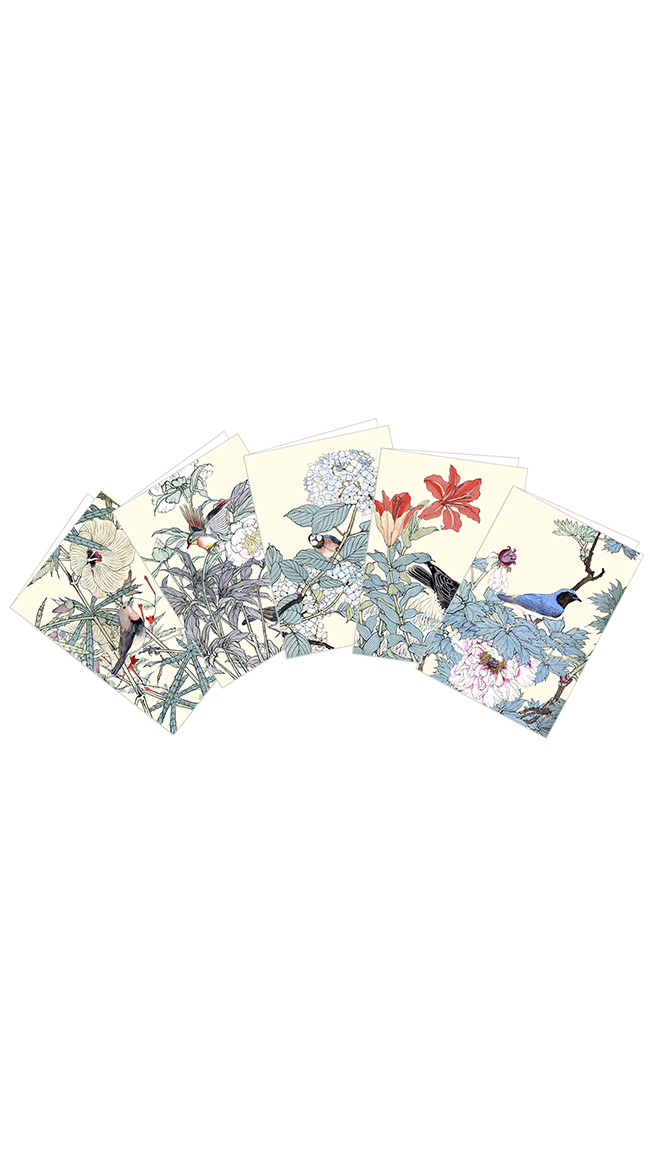
Moements with Imao, Keinen (1845-1924)
Japanese painter, calligrapher, printmaker and textile designer.
Imao Keinen was born in 1845 in Kyoto. He began his classical art education at age 11, studying painting in the Ukiyo-e style, a genre of Japanese art which flourished in the 17th to 19th centuries. Ukriyo-e artists produced woodblock prints and paintings.
He became a highly respected artist, printmaker, teacher, and calligrapher and his work can be found in many museums around the world.
His best known work Keinen Kachō Gafu (Flower and Bird Albums) was created in 1891, a collection of 4 albums of woodblock prints, one for each of the four seasons. "Kacho ga" is a term used for bird and flower prints. This form of art reached its peak in the late 19th century.
In 1919 he became a member of the Imperial Art Academy. In this period of his life he was probably the most famous painter of his time.
Moements with Bouquet & Birds
Source: Smithsonian Design Museum Drawing, pen and ink, graphite ca. 1800–1830.
A delightful collection of drawings from the Smithsonian. Colourful birds, flower bouquets and butterflies abound on these delightful notecards. A perfect gift for oneself or someone special.
Moements with Mary Vaux Walcott (1860-1940)
Mary Vaux Walcott was an American artist, naturalist and photographer. As a young child her family spent summers in the Canadian Rockies where she first developed her skills as a naturalist and watercolourist. 400 of her paintings were published in 1925 by the Smithonian Institution in a 5-volume edition “North American Wild Flowers”. This work was acclaimed for both the beauty and the accuracy of her studies of native flowers.
Moements with Joris (Georg) Hoefnagel (1542-1601)
Illumination from Mira calligraphiae monumenta
(The Model Book of Calligraphy) by Georg Bocksay
Mira calligraphiae monumenta is a 16th century calligraphy manuscript created by Georg Bocskay, between 1561 and 1562 to record all types of calligraphy; each page highlighting a new style of script. Bocskay was the imperial secretary to the Holy Roman Emperor Ferdinand I. 30 years later, Ferdinand’s grandson, the Emperor Rudolph II commissioned Joris (Georg) Hoefnagel (1542-1601), court artist and a renowned Flemish manuscript illuminator to enhance the original work. Hoefnagel enlivened his flower pieces with insects and attention to detail typical of his nature studies. His accurate images of nature greatly influenced the development of Flemish still life painting, in particular, floral still life.
It is hard to believe the design and harmony of Bocskay’s script with Hoefnagel’s illumination of flora and fauna wasn’t a collaboration between the two artists but was accomplished some decades apart.
"The Jewel Book of Anna von Bayern"
Kleinodienbuch der Herzogin Anna von Bayern
Thanks to Albrecht V, Duke of Bavaria (1528-1579) and his wife, the Archduchess Anna von Bayern (1610-1665) who documented their collection of extravagant jewellery, by commissioning a manuscript/inventory of the “BLING” in their possession, thus giving us a historical insight into Renaissance jewellery long after the precious gems have been recut, reset or lost.
The manuscript contained over a hundred gorgeous paintings on vellum and paper by Hans Mielich (1516-1573), a court painter from Munich who completed the work between 1552 and 1555. The work was presented to the Bavarian State Library by King Ludwig I in 1843.
Apart from the brilliant documentation of these jewels, one’s eye is also drawn to the truly amazing borders of classical and Renaissance ornamentation by Mielich.
Moements with Imao, Keinen (1845-1924)
Japanese painter, calligrapher, printmaker and textile designer.
Imao Keinen was born in 1845 in Kyoto. He began his classical art education at age 11, studying painting in the Ukiyo-e style, a genre of Japanese art which flourished in the 17th to 19th centuries. Ukriyo-e artists produced woodblock prints and paintings.
He became a highly respected artist, printmaker, teacher, and calligrapher and his work can be found in many museums around the world.
His best known work Keinen Kachō Gafu (Flower and Bird Albums) was created in 1891, a collection of 4 albums of woodblock prints, one for each of the four seasons. "Kacho ga" is a term used for bird and flower prints. This form of art reached its peak in the late 19th century.
In 1919 he became a member of the Imperial Art Academy. In this period of his life he was probably the most famous painter of his time.
Moements in the Temple of Flora
Dr. Robert Joseph Thornton (1768-1837). First published in 1798
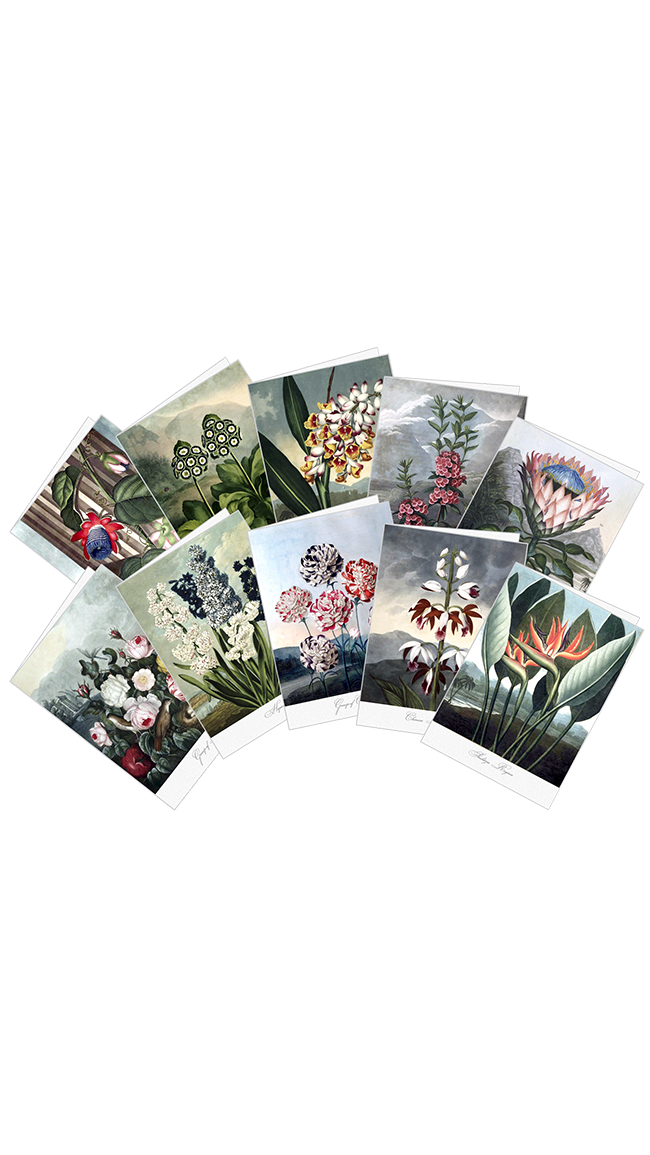
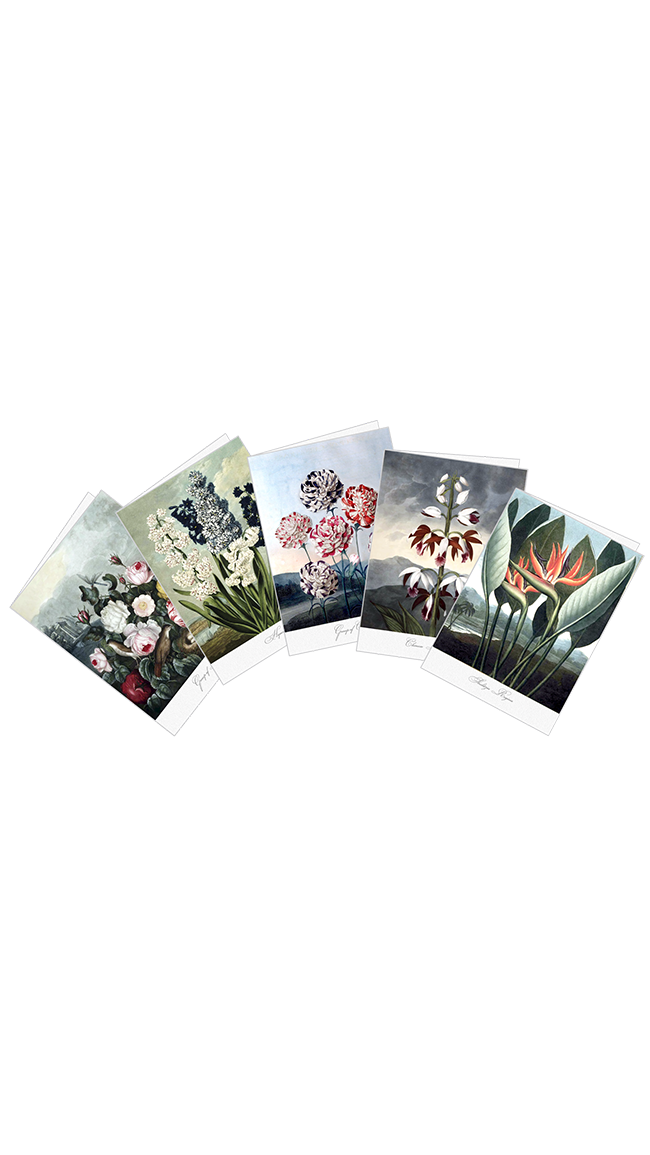
Images from Dr. Robert John Thornton’s ‘The Temple of Flora, or Garden of Nature. Published: London 1807.
The Temple of Flora is regarded by many as one of the most magnificent of all florilegia ever produced. Dr. Robert Thornton (1768-1837), physician and botanical writer, was not primarily an artist but the driving force behind this great work.
His vision: to produce ‘Picturesque Botanical Plates of the Choicest Flowers of Europe, Asia, Africa, and America’. Between 1798 and 1807, 32 coloured plates were engraved in aquatint, stipple and line from original paintings by noted British artists. For the text he engaged the foremost poets of the time to provide poems to accompany their botanical illustrations.
Lack of public interest spelt disaster for his project . Almost from the outset Thornton ruined himself by the lavish scale of this work and despite obtaining an Act of Parliament authorising him to organise a lottery to fund his botanical works and numerous publications, by the time of his death in 1837 his family was destitute.
Although his vision was not shared at the time, we can see from the beautiful images why it is one of our most popular set of Moements note cards and prints.
Moements with Mary Vaux Walcott (1860-1940)
Mary Vaux Walcott was an American artist, naturalist and photographer. As a young child her family spent summers in the Canadian Rockies where she first developed her skills as a naturalist and watercolourist. 400 of her paintings were published in 1925 by the Smithonian Institution in a 5-volume edition “North American Wild Flowers”. This work was acclaimed for both the beauty and the accuracy of her studies of native flowers.
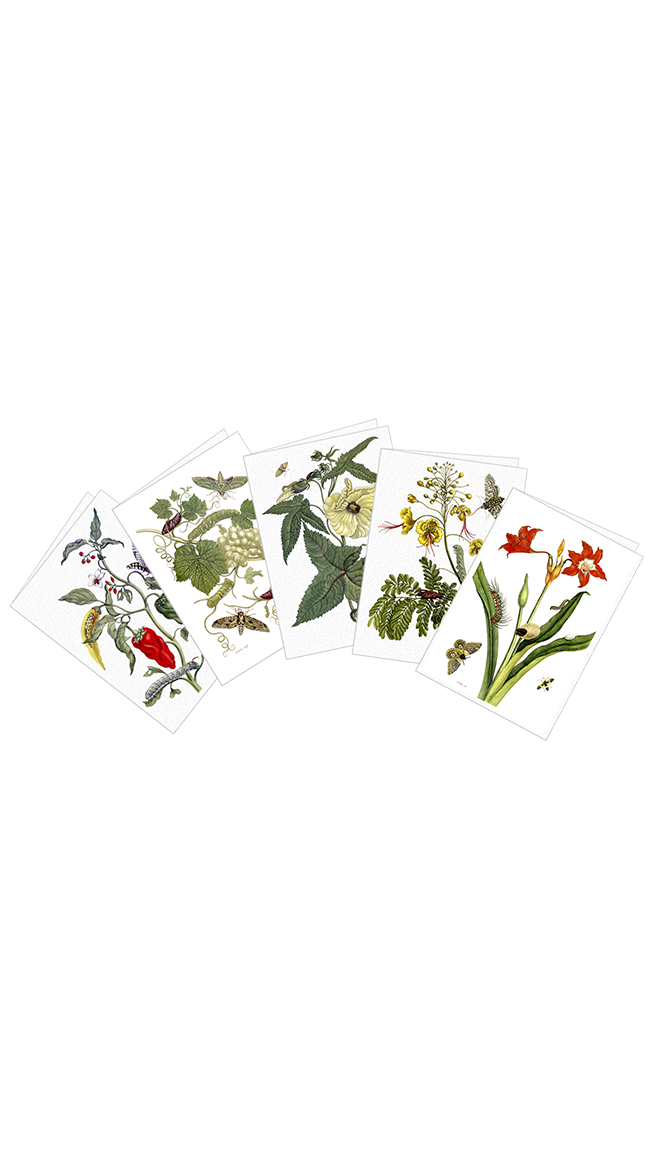
Metamorphosis insectorum Surinamensium
by Maria Sibylla Merian.
Published in Amsterdam 1705
Maria Sibylla Merian (1647-1717) was one of the foremost natural historians and artists of the 17th century.
She was born in Frankfurt, Germany into a family of artists, engravers and publishers. Although she came from the tradition of flower painting, at an early age she became interested in the metamorphosis of butterflies and insects and the plants on which they live.
She taught painting and drawing and published her own work.
In 1699 at the age of 52 she embarked on an expedition to Suriname (Dutch Guiana) in South America, where she documented her special interest of flora and fauna that lived in the jungle habitat of Suriname.
Two years later in 1701 she returned to Europe and began work on her illustrious book Metamorphosis Insectorum Surinamensium. Towards the time of her death in 1717, many of her watercolours were purchased by Czar Peter the Great of Russia. The 95 watercolours by Merian in the Royal Collection were bought by King George III, then Prince of Wales, in 1755.